

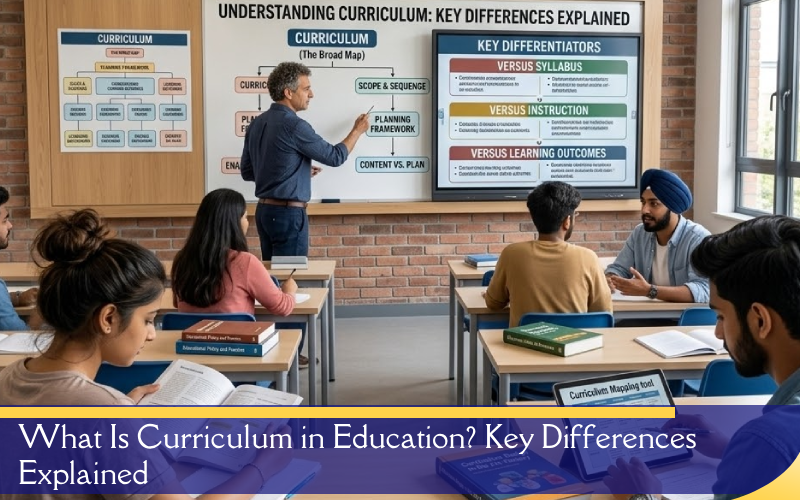
What Is Curriculum in Education? Key Differences Explained
The word ‘curriculum’ appears in almost every conversation about education — school prospectuses, policy documents, teacher training programmes, and parent meetings all reference it. Yet what the curriculum actually is, what it includes, and how it shapes a student’s learning experience is rarely explained with any clarity. This article provides a comprehensive overview of curriculum in education: what it means, what it contains, how it differs from a syllabus, and why the curriculum choices an institution makes have a profound and lasting impact on what students learn, how they learn it, and who they become.Defining Curriculum in Education
The term ‘curriculum’ derives from the Latin word currere, meaning ‘to run’ or ‘a course to be run.’ In education, curriculum refers to the totality of planned learning experiences that an educational institution provides to its students — encompassing not just what is taught, but how it is taught, in what sequence, for what purpose, and through what kinds of activities and assessments. A curriculum is, in this sense, far more than a list of topics. It is a comprehensive educational plan that reflects values, goals, and beliefs about what knowledge matters and what kind of person education should help develop. The curriculum framework adopted by a Best Educational Institute in Bangalore reveals a great deal about its educational philosophy — whether it prioritises breadth or depth, academic rigour or applied learning, standardised outcomes or individual development.Curriculum vs Syllabus: A Critical Distinction
The most common source of confusion in discussions about curriculum is the blurring of curriculum and syllabus. These are related but distinct concepts, and understanding the difference is essential for anyone navigating the education system.| Aspect | Curriculum | Syllabus |
|---|---|---|
| Scope | Broad — covers the entire educational programme | Narrow — covers a specific subject or course |
| Content | Goals, outcomes, methods, materials, activities, assessment | Topics, chapters, reading lists, and exam patterns for one subject |
| Set by | Educational boards, institutions, or national bodies | Teachers, departments, or examining boards for specific subjects |
| Duration | Spans an entire programme or level of schooling | Typically covers one academic year or one course |
| Flexibility | More structural; shapes the overall learning environment | More specific; can vary between schools following the same curriculum |
| Purpose | Defines what education should achieve overall | Defines what should be covered in one subject |
Components of a Curriculum
A well-designed curriculum is made up of several interrelated components, each of which shapes the learning experience in important ways:Aims and Goals
Every curriculum begins with a statement of purpose: what should education achieve? These overarching aims — which might include intellectual development, character formation, vocational preparation, civic awareness, or all of the above — shape every subsequent decision about content and method.Content
Content refers to what is to be taught — the knowledge, concepts, skills, and values that are the substance of the curriculum. Content selection reflects priorities: not everything can be included, so the curriculum represents a set of choices about what matters most.Learning Experiences
How students engage with content matters as much as what the content is. Learning experiences — lectures, discussions, laboratory work, field trips, projects, collaborative tasks, independent study — are the pedagogical methods through which curriculum content is delivered. Different learning experiences develop different kinds of capability.Assessment and Evaluation
A curriculum specifies how learning will be assessed and how student achievement will be evaluated. Assessment is not separate from curriculum — it is integral to it. The assessments used in a curriculum signal what the curriculum values: a curriculum that assesses only through written examinations values different capabilities than one that includes projects, presentations, and practical demonstrations.Organisation and Sequencing
The curriculum also specifies how content is organised and sequenced across years and subjects. Decisions about when certain topics are introduced, how subjects relate to each other, and how learning progresses from foundational to advanced are all curricular decisions.Types of Curriculum
Educators and curriculum theorists distinguish between several types of curriculum that operate simultaneously in any educational setting:The Formal (Written) Curriculum
The formal curriculum is the officially documented, intended curriculum — the one set out in policy documents, textbooks, and course guides. It states what is supposed to be taught and learned.The Taught Curriculum
The taught curriculum is what actually happens in classrooms — the content teachers choose to emphasise, the examples they use, the time they spend on different topics, and the methods they employ. The taught curriculum always differs somewhat from the formal curriculum, reflecting individual teacher judgement, available time, and classroom dynamics.The Hidden Curriculum
The hidden curriculum refers to the implicit lessons, values, and social norms that students learn through their experience of school — not from the formal content, but from the culture, structure, and relationships of the educational environment. Messages about authority, fairness, cooperation, and identity are all transmitted through the hidden curriculum, often more powerfully than through formal instruction. When parents choose a Best Educational Institute in Bangalore for their child, they are not just choosing a syllabus or an examination board — they are choosing a hidden curriculum: a set of values, expectations, and ways of relating that will shape their child’s development as much as any textbook.The Null Curriculum
The null curriculum refers to what is not taught — the topics, perspectives, and knowledge that are deliberately or accidentally excluded. What a curriculum leaves out is as revealing as what it includes, because exclusions shape what students believe is important, legitimate, or worth knowing.Major Curriculum Frameworks in India
In India, the curriculum framework for school education is governed by the National Curriculum Framework (NCF), developed by the National Council of Educational Research and Training (NCERT). The NCF provides the philosophical and pedagogical foundation for school education, while individual boards — CBSE, ICSE, state boards — develop their own syllabi and examination structures within this framework. The NEP 2020 (National Education Policy) has introduced a significant shift in curriculum thinking — moving toward a competency-based curriculum that emphasises understanding, application, and critical thinking over rote memorisation, and restructuring schooling into new stage-based phases that better reflect children’s developmental needs.What Makes a Good Curriculum?
A high-quality curriculum shares several characteristics that distinguish it from a merely adequate one:- Coherence — subjects and learning experiences connect to each other meaningfully, rather than existing in isolation
- Relevance — content connects to students’ lives, contexts, and futures, not just to academic tradition
- Balance — the curriculum addresses intellectual, social, physical, aesthetic, and values-based development, not just academic subject knowledge
- Progression — learning is sequenced so that each stage builds on the previous one and prepares for the next
- Inclusivity — the curriculum is accessible to and respectful of students with different backgrounds, abilities, and learning styles
- Alignment — aims, content, learning experiences, and assessments are all aligned with each other, so that what is taught is what is tested and what is learned
Curriculum and Student Outcomes
The relationship between curriculum design and student outcomes is well-established. Students who experience a coherent, well-sequenced curriculum with varied learning experiences and aligned assessment consistently develop deeper understanding and broader capabilities than those exposed to a fragmented or examination-focused curriculum. Beyond academic achievement, curriculum choices shape character, values, creativity, and the disposition to continue learning throughout life. An education that develops these qualities alongside subject knowledge produces graduates who are equipped not just for examinations but for everything that follows.Key Takeaways
- Curriculum refers to the totality of planned learning experiences — including content, methods, sequencing, and assessment — not just a list of topics
- The curriculum is broader than the syllabus: the curriculum covers the whole educational programme, while a syllabus covers one subject within it
- A curriculum has multiple layers: the formal (written) curriculum, the taught curriculum, the hidden curriculum, and the null curriculum
- Good curriculum design is coherent, relevant, balanced, progressive, inclusive, and aligned
- Curriculum choices reflect educational values — and shape student outcomes far beyond examination performance
Conclusion
Understanding what curriculum means in education is not just an academic exercise — it has practical consequences for every choice students and parents make about schooling. When you understand that curriculum encompasses goals, content, learning experiences, and assessment together, you are better equipped to evaluate educational institutions, advocate for your own learning, and appreciate why some educational experiences feel genuinely transformative while others feel like mere preparation for examinations. The curriculum is the design of education itself — and it deserves to be taken seriously.FAQs
- What is the difference between curriculum and syllabus?
- What are the main types of curriculum?
- What does a curriculum include?
- Who designs the curriculum in India?
- What is the hidden curriculum?
- How does NEP 2020 change the curriculum in India?
- What is a competency-based curriculum?
- Why does curriculum matter more than just the textbook?