
1. Game Design Event
| Venue | NHCE MCA Classrooms |
| Date | 26 – March – 2026 |
| Time | 10:am to 6:00pm |
| Faculty Co-ordinator Name | Dr. Lavanya C |
| Designation | Senior Assistant Professor |
| Department | CSE |
1. Introduction
- The Game Design Event was organized to provide students with practical exposure to game development, combining theoretical understanding with hands-on implementation. The event aimed to enhance creativity, problem-solving skills, and technical knowledge by allowing participants to design and develop their own games using modern tools and technologies.
2. Event Description
- The event began with an expert lecture delivered by an invited industry mentor/guest speaker with experience in game development.
- It focused on:
- Fundamentals of game design
- Industry practices and workflows
- Tools and technologies used in modern game development
- The session was interactive, allowing students to:
- Ask questions
- Clarify doubts
- Gain deeper insight into real-world game development challenges
- After all queries were addressed, the event transitioned into the practical phase—the Game Development Challenge.
Challenge Setup
- Each participant was asked to randomly pick a chit from a bowl.
- The chit assigned the genre of the game, which included:
- Arcade
- Puzzle
- Racing
Development Rules
- Students were required to develop a game based on the assigned genre.
- The only restriction was:
- No use of pre-built or imported games
- Participants were encouraged to use:
- AI tools such as ChatGPT, Gemini, and Antigravity
- Game development platforms like Unity
- Any other relevant tools or frameworks
- This open environment allowed students to explore modern development workflows, including AI-assisted coding and rapid prototyping.
3. Outcome and Observations
- Students demonstrated high engagement and creativity
- Effective use of AI tools and modern technologies was observed
- Participants gained:
- Practical development experience
- Better understanding of game design principles
- Exposure to industry-level thinking
4. Conclusion
- The Game Design Event was a successful blend of theoretical learning and practical implementation. The initial lecture provided students with a strong conceptual foundation, while the hands-on challenge encouraged them to apply their knowledge creatively.
- The inclusion of AI tools and open-ended development environments allowed students to explore innovative approaches, making the event highly relevant to current industry trends. Overall, the event effectively enhanced students’ skills, confidence, and interest in game development.
2. GIT OUT Event
| Venue | NHCE Idea Lab and Nirvana |
| Date | 26 – May – 2026 |
| Time | 11:00 am to 5:00 pm |
| Faculty Co-ordinator Name | Dr. Lavanya C |
| Designation | Senior Assistant Professor |
| Department | CSE |
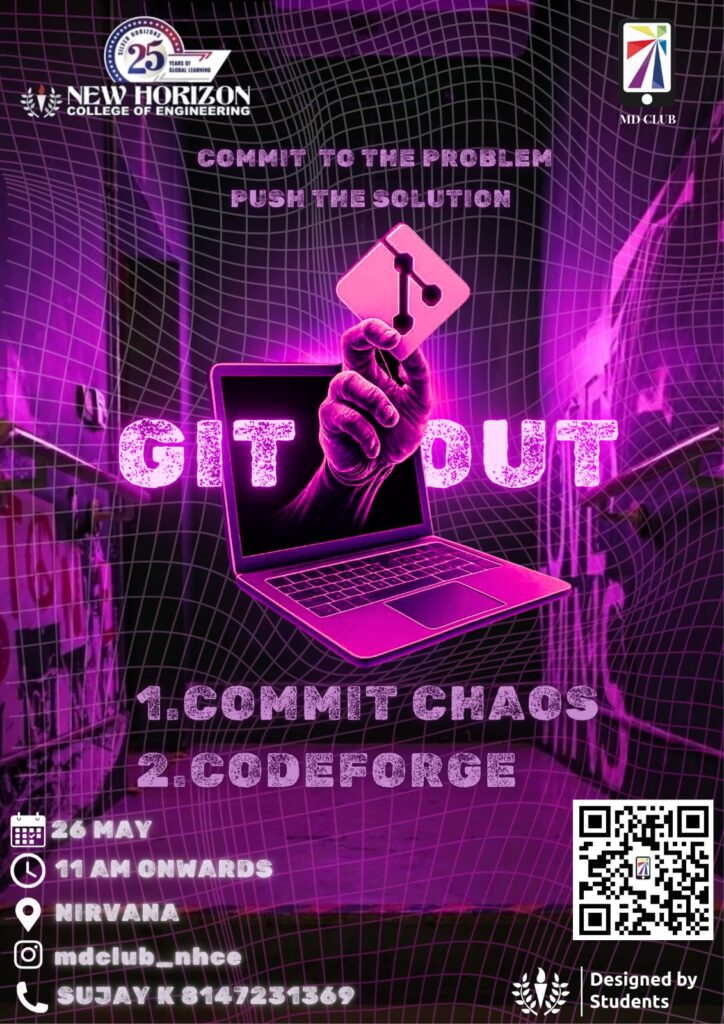
Description of the Event: On May 26, 2026, a high-intensity, overnight technical event titled “Git Out” was successfully organized. Commencing at 11:00 PM, the event challenged participants’ command over version control systems, rapid problem-solving abilities, and full-stack development skills. Held across two distinct venues—Nirvana and the Idea Lab—the event witnessed intense competition across two meticulously designed rounds: Commit Chaos and CodeForge.
Round-by-Round Breakdown
Round 1: Commit Chaos
• Venue: Nirvana
• Format: Git-Themed Escape Room
• Description: Teams were pushed into a virtual “escape room” scenario where progress was entirely dependent on their mastery of Git commands. Instead of traditional riddles, participants had to resolve complex merge conflicts, untangle messy commit histories, and use advanced Git syntax to unlock clues.
• The Reward: Successfully “escaping” the room unlocked a unique, team-specific problem statement encrypted within a repository, bridging them directly to the next phase of the hackathon.
Round 2: CodeForge
• Venue: Idea Lab
• Format: Repository Cloning, Full-Stack Development, and Pitching
• Description: Moving into the Idea Lab, teams utilized the Git knowledge tested in Round 1 to pull the remote repository containing their unique problem statement.
• The Challenge: Teams were required to build an end-to-end application addressing their assigned problem completely from scratch. The overnight environment pushed teams to collaborate efficiently using Git branches to integrate features smoothly.
The Finale: The event concluded with a high-stakes pitching session. Each team demonstrated their deployed or functional application and pitched their architecture, codebase structure, and solution scalability to the panel of judges.
Key Highlights & Outcomes
• Experiential Learning: By blending a gamified escape room with a practical hackathon, the event successfully bridged theoretical version control concepts with real-world collaborative development.
• Unique Tracks: Providing a distinct problem statement to each team ensured absolute academic integrity and a diverse range of final product pitches.
• Resource Utilization: The seamless transition from the collaborative space in Nirvana for the escape room to the high-productivity environment of the Idea Lab kept energy levels high throughout the night.
Conclusion
“Git Out” proved to be a resounding success, pushing participants past the boundaries of conventional coding loops into the vital territory of repository management and rapid deployment. The event concluded with the evaluation of the pitches, showcasing impressive technical depth and innovative solutions built entirely from the ground up under tight time constraints.